Every business wants its website to appear on the first page of Google. Higher search rankings can bring more visitors, increase brand awareness, and generate valuable business leads. However, the methods used to achieve those rankings matter just as much as the results.
Some websites try to improve their search engine rankings through shortcuts and manipulative practices. These methods are commonly known as Black Hat SEO.
Table of Contents
While certain Black Hat SEO techniques may generate temporary results, they can also damage a website’s search visibility, credibility, and long-term growth.
So, what exactly is Black Hat SEO? Does it still work? And how is it different from White Hat SEO?
In this guide, we’ll explore common Black Hat SEO techniques, their potential risks, and why ethical SEO strategies are a better investment for businesses seeking sustainable online growth.
What Is Black Hat SEO?
Black Hat SEO refers to search engine optimization techniques that attempt to manipulate search rankings rather than provide genuine value to website visitors.
These practices typically violate search engine spam policies and are designed to influence ranking systems through artificial methods.
For example, a website might repeatedly insert keywords into its content, purchase large numbers of artificial backlinks, or create hundreds of low-quality pages to attract search traffic.
Although these tactics may appear attractive to businesses seeking quick results, they can create serious problems over time.
Google uses automated spam-detection systems and manual reviews to identify practices that violate its policies. Websites engaging in such activities may experience ranking declines, manual actions, or removal of affected pages from search results.
Understanding these risks helps businesses make informed decisions before investing in SEO services.
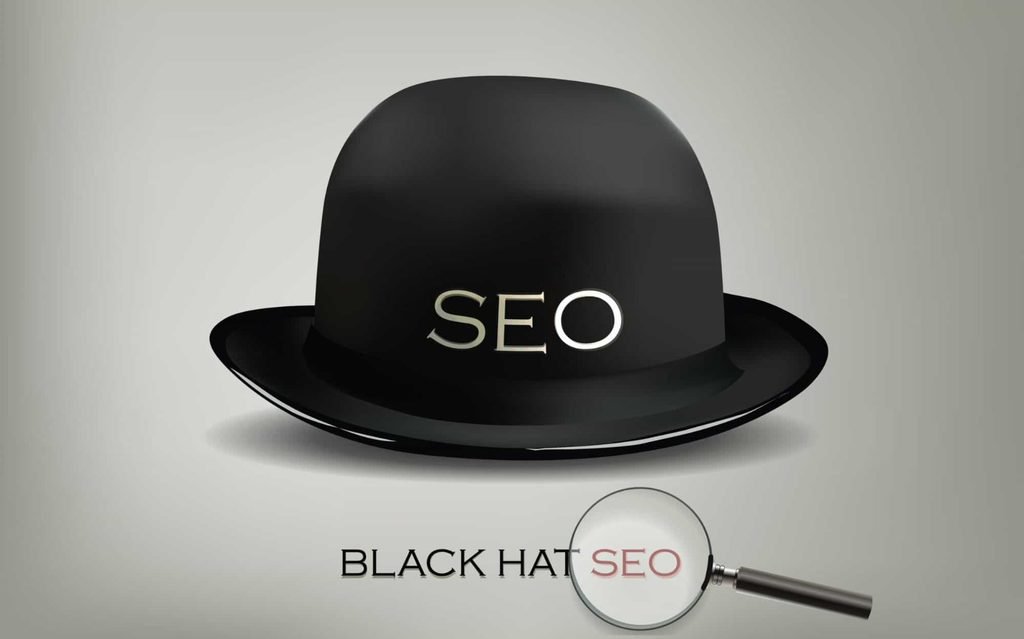
8 Common Black Hat SEO Techniques You Should Know
Black Hat SEO includes several practices intended to manipulate search rankings. Here are eight common techniques businesses and website owners should understand.
1. Keyword Stuffing
Keyword stuffing occurs when a website repeats the same keywords excessively to influence search engine rankings.
For example, a website offering digital marketing services in Pune might repeatedly use phrases such as “best SEO agency in Pune” throughout its content, even when the repetition makes sentences unnatural.
This approach reduces readability and can negatively affect the user experience.
Better approach: Use your primary keyword naturally in relevant headings and content. Include related terms where they help explain the topic, and prioritize answering the reader’s questions.
2. Cloaking
Cloaking involves deliberately showing search engines different content from what regular visitors see to manipulate rankings or mislead users.
For instance, a website might present an informative educational article to search crawlers while directing visitors to an unrelated commercial page.
This creates a misleading experience and violates Google’s spam policies when used for manipulation.
Better approach: Ensure search engines and visitors can access equivalent, relevant information about your website’s actual content and purpose.
3. Hidden Text and Hidden Links
Some websites attempt to manipulate rankings by placing keywords or links where ordinary visitors cannot easily see them.
Examples include white text on a white background, links hidden behind images, or text positioned outside the visible screen.
The intention is to influence search engines without displaying the same information to users.
However, not all hidden content is problematic. Legitimate accordion sections, responsive navigation menus, and accessibility features can be entirely appropriate.
Better approach: Keep meaningful content accessible and use design elements to improve usability rather than conceal manipulative keywords or links.
4. Link Schemes and Artificial Backlinks
Backlinks can help search engines discover content and understand relationships between websites.
However, some businesses attempt to manipulate rankings by purchasing links that pass ranking credit, participating in excessive link exchanges, or using automated link-building networks.
Such practices can lead to link spam issues.
Better approach: Earn relevant backlinks through original research, useful resources, digital PR, business relationships, and genuinely valuable content.
5. Private Blog Networks (PBNs)
A Private Blog Network is a collection of websites often controlled by the same person or organization, primarily used to create artificial backlinks to another website.
The objective is usually to influence the target website’s search rankings.
When these networks exist primarily to manipulate ranking signals, they can violate search engine policies.
Better approach: Build an authentic online presence through authoritative content, relevant mentions, and relationships with legitimate websites in your industry.
6. Doorway Pages
Doorway pages are created primarily to rank for specific, similar search queries and direct visitors toward essentially the same destination.
For example, a company might create numerous nearly identical city-based pages with little unique local information.
When these pages provide no meaningful individual value, they may be considered doorway abuse.
Better approach: Develop location-specific landing pages only when they offer genuinely relevant information, such as distinct services, office details, service availability, or useful local guidance.
7. Low-Value Automated and Duplicate Content
Publishing large volumes of low-quality content solely to attract search traffic is another problematic SEO practice.
This can include automatically generated articles, scraped information, or pages that repeat existing material without adding meaningful value.
Importantly, using AI to assist with content creation or publishing similar information is not automatically a violation.
The risk arises when large quantities of unoriginal content are produced primarily to manipulate rankings rather than help users.
Better approach: Create useful, accurate, original content that answers real customer questions and demonstrates genuine subject knowledge.
8. Negative SEO
Negative SEO refers to attempts to harm another website’s search performance through manipulative or malicious actions.
Examples may include creating unwanted spam links, publishing copied content, or targeting a website through unauthorized spam activity.
Not every suspicious backlink or ranking decline indicates a negative SEO attack. Technical issues, competition, indexing changes, and other factors can also affect search performance.
Better approach: Monitor website security, organic traffic, indexing, and backlink patterns. Investigate suspicious activity using reliable evidence before taking action.
Does Black Hat SEO Still Work?
One of the most common questions among website owners is whether Black Hat SEO techniques can still improve Google rankings.
The short answer is that some manipulative SEO tactics may produce temporary results, but they are unpredictable and carry significant risks.
A website might initially experience an increase in organic traffic after aggressive backlink building or publishing large numbers of keyword-targeted pages.
However, that improvement does not necessarily indicate a sustainable SEO strategy.
Google continues to refine its search systems to identify spam, improve search quality, and prioritize helpful information.
When manipulative practices are detected, their impact can be reduced, or affected websites may face additional action.
Major Risks of Black Hat SEO
1. Declining search rankings
Websites relying on manipulative tactics may lose positions when ranking systems identify or discount those signals.
2. Google manual actions
A manual action can occur when Google’s reviewers identify violations of its spam policies. This may affect specific pages or an entire website.
3. Reduced organic traffic
A ranking decline can significantly reduce search visibility, leading to fewer visitors and fewer opportunities to generate leads.
4. Financial losses
Businesses may spend money on artificial backlinks, low-quality content, and ineffective SEO campaigns without building lasting value.
5. Damage to brand credibility
Poor-quality content, misleading pages, and spammy website practices can weaken customer confidence.
6. Expensive recovery efforts
Recovering from SEO problems may require backlink reviews, content improvements, technical corrections, and ongoing monitoring.
For businesses depending on organic search to generate enquiries and sales, the potential long-term costs often outweigh the temporary benefits.
Black Hat SEO vs White Hat SEO: What’s the Difference?
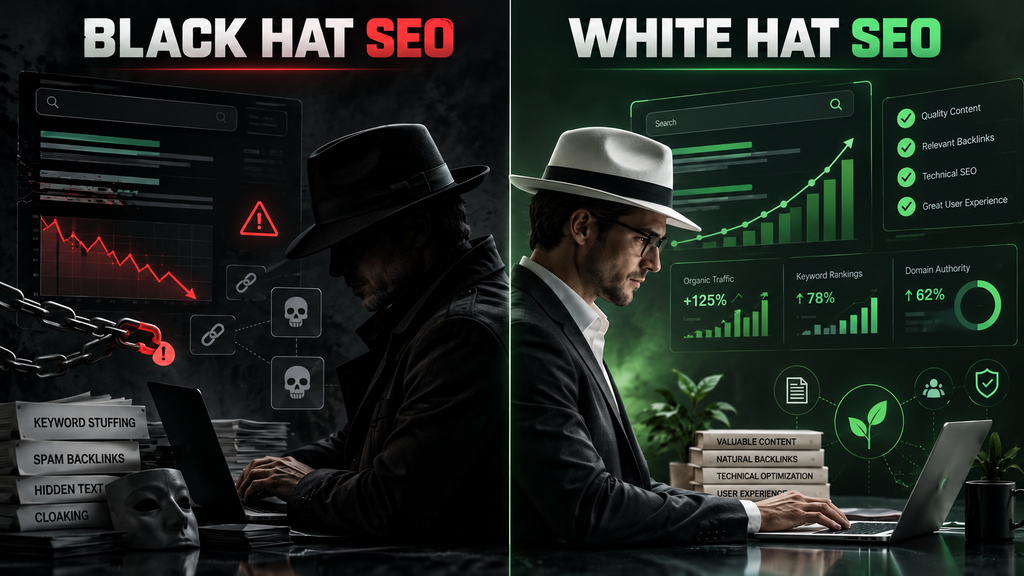
Although both approaches aim to improve search visibility, Black Hat SEO and White Hat SEO differ significantly in their methods and long-term impact.
| Comparison Factor | Black Hat SEO | White Hat SEO |
|---|---|---|
| Main approach | Manipulates ranking systems | Follows search engine guidelines |
| Content quality | Often repetitive or low-value | Helpful and audience-focused |
| Keyword optimization | Excessive or unnatural usage | Natural, search-intent-based usage |
| Backlink strategy | Artificial links and link schemes | Relevant, editorially earned links |
| User experience | Often secondary to rankings | Prioritizes website visitors |
| Risk level | High | Lower when compliant |
| Ranking stability | Unpredictable | More sustainable, though not guaranteed |
| Long-term value | Limited and uncertain | Supports lasting brand authority |
| Business objective | Rapid ranking manipulation | Consistent organic business growth |
Why White Hat SEO Is Better for Long-Term Growth
White Hat SEO focuses on improving a website’s genuine usefulness, technical performance, discoverability, and relevance.
Rather than trying to exploit search engine systems, it helps businesses develop a stronger digital foundation.
Effective White Hat SEO strategies typically involve:
- Conducting keyword research based on customer search intent.
- Creating original, informative website content.
- Improving website speed and mobile usability.
- Optimizing page titles, meta descriptions, and headings.
- Fixing technical SEO and indexing issues.
- Building relevant backlinks through legitimate methods.
- Improving internal linking and website navigation.
- Monitoring performance using Google Search Console and Google Analytics.
- Optimizing relevant business profiles for local search visibility.
These practices support both search visibility and customer experience.
While White Hat SEO does not guarantee specific rankings, it generally offers a more dependable foundation for long-term growth.
What Is Grey Hat SEO?
Grey Hat SEO describes techniques that are sometimes perceived as falling between Black Hat and White Hat SEO.
These may involve aggressive optimization methods that appear less obviously manipulative but still raise questions about compliance with search engine guidelines.
However, Grey Hat SEO is not an official Google classification.
A technique does not become safe simply because marketers describe it as Grey Hat.
Businesses should evaluate the actual practice against Google’s published policies instead of relying on labels.
For organizations investing in long-term digital growth, transparent and policy-compliant SEO practices remain the safer choice.
What Are Black Hat SEO Websites?
Black Hat SEO websites are sites that primarily use manipulative techniques to gain visibility in search engine results.
These websites may appear in different forms, including:
Artificial backlink websites: Platforms or networks created mainly to sell links that manipulate search rankings.
Spam content websites: Websites publishing large quantities of low-value pages with little original information.
Doorway websites: Sites containing multiple similar landing pages designed to capture related search queries.
Compromised websites: Legitimate websites that have been hacked and used to distribute unauthorized spam pages or links.
Cloaked websites: Websites deliberately presenting misleading differences between crawler-facing and user-facing content.
It is important to understand that a website should not automatically be classified as a Black Hat SEO site simply because it has poor design, low-quality content, or unexpectedly high rankings.
A proper SEO audit and supporting evidence are necessary before making that determination.
How to Identify Black Hat SEO Practices on Your Website
Many business owners outsource SEO without fully understanding the methods used by their service providers.
Unfortunately, some may discover problematic practices only after their website experiences significant ranking fluctuations.
Regular SEO audits can help identify potential risks.
Start by reviewing the following areas:
Content quality: Check whether website pages contain excessive keyword repetition, copied information, or large amounts of unhelpful content.
Backlink profile: Examine referring websites and investigate suspicious link patterns. Remember that an unfamiliar backlink is not automatically harmful.
Google Search Console: Review manual actions, indexing reports, search performance trends, and security notifications.
Location landing pages: Check whether location-specific pages provide unique and meaningful information.
Website security: Look for unauthorized pages, unexpected redirects, and changes to website files.
SEO reporting: Ask your agency to explain its link-building methods, content strategy, and measurable performance indicators.
A transparent SEO strategy should explain both what is being done and why those activities benefit the business.
How to Recover From Black Hat SEO Problems
If your website has been affected by manipulative SEO practices, the right recovery strategy depends on the underlying problem.
Step 1: Conduct a Complete SEO Audit
Review technical performance, website content, backlinks, indexing, security, and organic traffic trends to identify possible issues.
Step 2: Check for Google Manual Actions
Use Google Search Console to determine whether your website has received a manual action and follow the instructions associated with the identified violation.
Step 3: Improve Low-Quality Content
Rewrite, consolidate, or remove content that offers little value. Prioritize original information, accurate explanations, and helpful answers.
Step 4: Investigate Manipulative Backlinks
If your website has participated in artificial link schemes, work toward removing problematic links where appropriate.
Google’s disavow tool should be used carefully and is generally intended for significant artificial-link problems, not ordinary low-quality links.
Step 5: Resolve Technical and Security Issues
Address unauthorized redirects, hacked content, indexing errors, and other technical problems that may affect search performance.
Step 6: Rebuild With a Sustainable SEO Strategy
Focus on useful content, technical improvements, relevant backlinks, and measurable business outcomes.
If a manual action was applied, request reconsideration after adequately correcting the violations.
Recovery timelines vary depending on the issue, and improvements in rankings are not guaranteed.
Best White Hat SEO Practices for Business Websites
A successful SEO strategy should focus on reaching the right audience rather than simply attracting more visitors.
For example, a service-based business in Pune may benefit more from relevant enquiries generated through targeted keywords than from thousands of unrelated website visits.
Businesses can build a stronger SEO foundation by combining several important activities.
Technical SEO
Improve website crawlability, indexing, site architecture, mobile usability, page performance, and structured data implementation.
On-Page SEO
Optimize important service pages with descriptive headings, relevant keywords, informative content, internal links, and meaningful metadata.
Content Marketing
Publish educational blog posts, service guides, FAQs, and resources that address the questions prospective customers are asking.
Local SEO and Google Business Profile Optimization
For eligible businesses, maintain accurate business information, relevant categories, useful updates, and a consistent local presence.
Ethical Link Building
Develop authentic backlinks through valuable content, partnerships, industry mentions, and relevant digital PR activities.
Conversion Rate Optimization
Improve contact forms, calls to action, website navigation, and landing-page experiences to help visitors take meaningful business actions.
Combining these approaches can help businesses improve organic discoverability while building trust with prospective customers.
Frequently Asked Questions About Black Hat SEO
1. Is Black Hat SEO illegal?
Black Hat SEO is not automatically illegal. However, many techniques violate search engine spam policies, and certain activities, such as hacking or fraud, may also violate applicable laws.
2. Can Black Hat SEO improve Google rankings?
Some techniques may temporarily influence rankings, but results are unreliable. Search engines may ignore manipulative signals, reduce rankings, or apply manual actions.
3. What is the biggest risk of Black Hat SEO?
One of the biggest risks is losing organic search visibility. Businesses may experience ranking declines, traffic losses, and fewer customer enquiries.
4. Is buying backlinks considered Black Hat SEO?
Buying backlinks primarily to manipulate rankings can violate Google’s link spam policies. Advertising and sponsored links are different when appropriately qualified, such as using the rel="sponsored" attribute.
5. Is AI-generated content Black Hat SEO?
No. AI-generated content is not automatically considered Black Hat SEO. The concern arises when automation is used to produce large amounts of low-value content primarily to manipulate rankings.
6. What is the difference between Black Hat, White Hat, and Grey Hat SEO?
Black Hat SEO uses manipulative methods, White Hat SEO emphasizes policy-compliant optimization and user value, and Grey Hat SEO is an informal label for tactics perceived as falling between the two.
7. How do I know if my SEO agency is using Black Hat techniques?
Ask for clear reports explaining content changes, backlinks, keyword strategies, and technical work. Review Search Console data and consider an independent SEO audit if you identify suspicious practices.
8. Which SEO strategy is best for long-term business growth?
White Hat SEO is generally the more sustainable approach because it emphasizes useful content, technical improvements, relevant visibility, and a better customer experience.
Conclusion: Choose Sustainable SEO Over Short-Term Ranking Tricks
Black Hat SEO may promise quick visibility, but search rankings built through manipulation can be difficult to maintain.
For businesses investing in digital marketing, success should not be measured only by keyword positions.
The real objective is to attract relevant visitors, build customer confidence, generate qualified leads, and create sustainable business opportunities.
A well-planned White Hat SEO strategy supports these goals through technical optimization, useful content, legitimate backlinks, and continuous performance improvement.
Build Long-Term Organic Growth With Digital Techists Consulting LLP
At Digital Techists Consulting LLP, Pune, we believe an effective SEO strategy should connect search visibility with meaningful business results.
Our digital marketing approach focuses on improving website performance, strengthening content relevance, optimizing on-page and technical SEO, supporting local search visibility, and creating better conversion opportunities.
Whether your business needs an SEO audit, website optimization, keyword strategy, content improvement, or Google Business Profile management, building a strong digital foundation is an important first step.
Looking to improve your website’s organic visibility with a sustainable SEO strategy?
Explore SEO solutions from Digital Techists Consulting LLP and take the next step toward stronger online visibility and business growth.
Remember: Strong SEO is not about manipulating search engines. It is about making your website more useful, discoverable, and valuable to the people searching for your services.